This guide restructures the self-examination instructions published by the Tennessee Breast Center. It is general knowledge, not medical advice — read our full disclaimer.
A monthly breast self-examination (BSE) helps you learn what is normal for your breasts, so that a change stands out. Women who examine themselves regularly find 80%–90% of the masses in their own breasts, often at half the size a physician would feel. The exam takes only a few minutes.
When to examine: one week after your period, when the breasts are least tender. If you no longer have periods, pick a fixed day every month — the first day of the month is easy to remember.
Step 1 — Visual inspection in the mirror
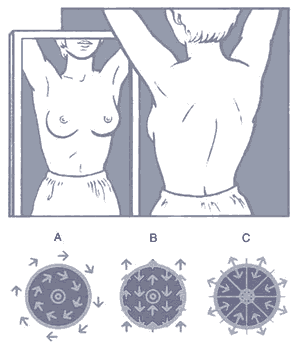
Stand in front of a mirror with your arms at your sides, then raise your arms above your head and lean forward, which accentuates any change in contour.
- Do the breasts look the same in size and shape as usual?
- Is there any skin dimpling, an abnormal bulge, or redness?
- Is the skin smooth, or thickened with prominent hair follicles (peau d’orange)?
- Do the nipples point the same direction as before? Any new inversion, scaling or discharge?
Step 2 — Examination upright
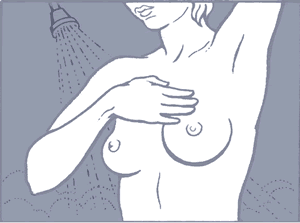
The easiest place is in the shower or bath, where soap and water let your fingers glide. Raise one arm and use the flat of the fingertips of the opposite hand — firm pressure is needed to feel the internal structures. Examine the right breast with the left hand, and the left breast with the right hand.
- Cover the whole breast in a pattern: up and down rows, circles, or a radial “starburst” from the nipple outward — consistency matters more than the pattern.
- The tissue normally feels lumpy in groups (lobules, like the petals of a flower); compare one breast with the other — they should feel alike.
- Feel the armpit (axilla) for small firm nodes.
Step 3 — Examination lying down
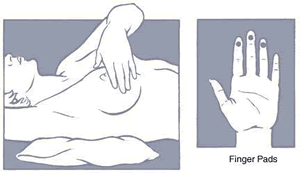
Lie down with a pillow under the shoulder of the side being examined. The breast tissue spreads flat against the chest wall, making masses easier to feel. Repeat the same systematic pattern, then switch sides. Many masses can only be felt in one position — that is why both steps matter.
What changes should you report?
- A new lump, or a thickening that is new compared with the other breast
- Bloody or clear-yellow discharge from a single duct in one breast, noted spontaneously
- Skin dimpling, an abnormal bulge, redness or thickening of the skin
- A new inverted nipple, or scaling of the nipple
- A firm lump in the armpit
Most findings are benign — 80%–90% of masses found by exam or mammography are not cancer — but any new, persistent change deserves a physician’s evaluation. See also: early detection and screening guidelines and the answers to common questions.