This page presents educational information originally published by the Tennessee Breast Center. It is general knowledge, not medical advice — read our full disclaimer.
Overview and the Milk Line
During the fifth week of human development, the embryo develops a milk line extending from the armpit to the groin. This usually disappears as the breast tissue forms. In 2–6% of women, however, the band persists and accessory breast tissue can occur anywhere along the line — from accessory nipples to fully developed, functioning breast tissue.
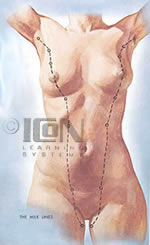
The importance of accessory breast tissue is that it is susceptible to the same disease processes as the breast itself. Around the time of delivery, colostral milk (“witches’ milk”) can be expressed from the nipple for 4–7 days postpartum in either sex; this secretion usually declines over the next three to four weeks.
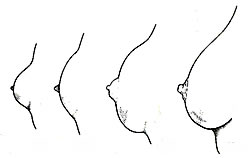
Approximately one year before the onset of menses, females develop a breast bud — an area of firmness under the nipple-areolar complex, sometimes with sensitivity or tenderness. This development responds to pituitary hormones (FSH and LH) and subsequent ovarian hormones (estrogen and progesterone).
Mistaking this normal growth for a pathologic condition — and biopsying or otherwise injuring the breast bud — can result in severe deformity of the breast. The breast continues to mature through the adolescent years but is never fully developed until lactation (milk production).
Congenital and Developmental Abnormalities of the Breast
The most common abnormality of development is an accessory nipple, which can occur anywhere along the milk line and is frequently mistaken for a mole. Accessory breast tissue along the line can occasionally function, if associated with a nipple, during lactation.
Underdevelopment of the breast (hypoplasia) or congenital absence of the breast (amazia) can occur. Most of these abnormalities are not severe. The severest deformities — amastia (absent breast) or hypoplasia (underdeveloped breast) — occur with underlying abnormalities of the pectoralis muscle 90% of the time (Poland’s syndrome: congenital absence or underdevelopment of the breast, pectoralis muscle and rib cage).
Virginal hypertrophy is the asymmetric and excessive growth of one breast over the other during adolescence. It can be corrected with surgery during the twenties, allowing the opposite breast an opportunity to catch up.
* Illustrations copyright 1965. Icon Learning Systems, LLC, a subsidiary of MediMedia USA Inc. Reprinted with permission from ICON Learning Systems, LLC, illustrated by Frank H. Netter, MD. All rights reserved.